
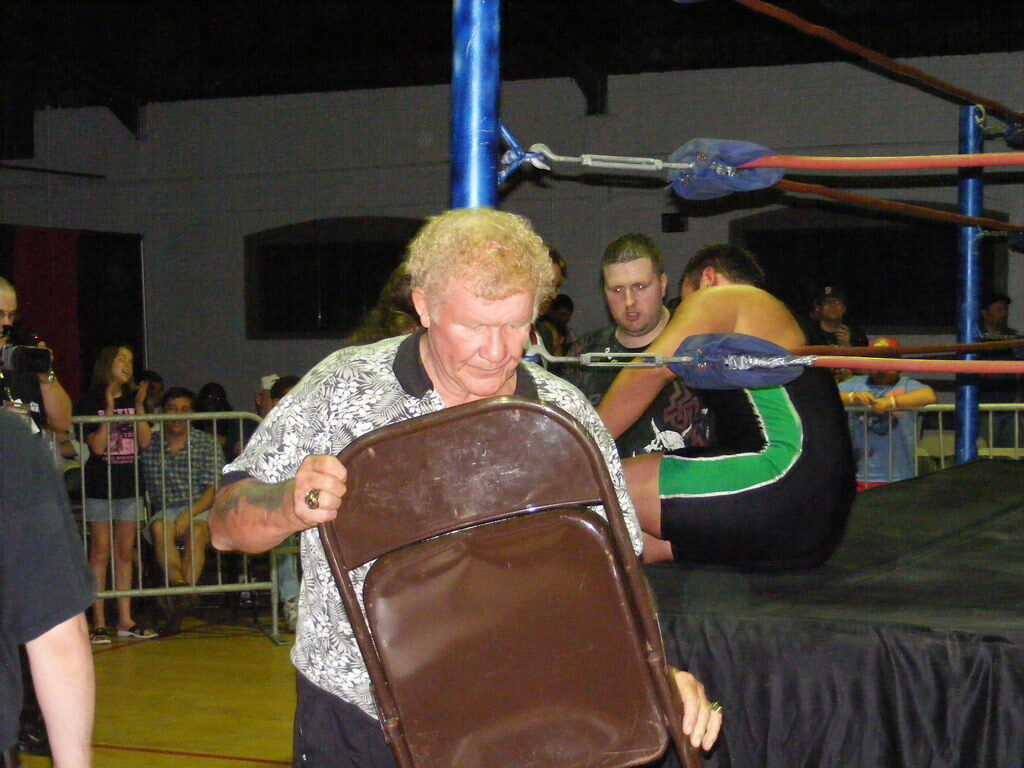
Harley Race (1943 – 2019)
Before Harley Race ever wore a championship belt, he was told he might never walk again. Before he became the man other men measured themselves against, he buried a wife. Before he was king of anything, he was a teenager from Quitman, Missouri, with a bad leg, no diploma, and nowhere obvious to go. What followed was one of the most decorated careers in the history of professional wrestling — built not on luck or timing, but on a particular kind of stubbornness that the sport has rarely seen since.
Ring Names: The Great Mortimer, Jack Long, Handsome Harley Race, Harley Race, The King, King Harley Race
The Making of a Hard Man
Race was born on April 11, 1943, to sharecroppers Jay Allen and Mary Race in Quitman, Missouri. He overcame polio as a child, and as a teenager began training under former world champions Stanislaus and Władek Zbyszko, who ran a farm in his home state. His formal education ended when a fight at school led to the principal kneeing him in the back of the head. Race attacked him and was expelled. Already 6-foot-1 and 225 pounds, he made a decision that would define the next six decades of his life.
He got into wrestling.
St. Joseph promoter Gust Karras brought him in to do odd jobs — including chauffeuring the 800-pound Happy Humphrey, who was too large to drive himself. Eventually, Race started appearing on Karras’ cards, and the veterans around him helped sharpen what the Zbyszko brothers had started.
At 18, he moved to Nashville and began working as Jack Long, forming a tag team with storyline brother John Long (real name Billy Strong). They won the Southern Tag Team Championship. Race was on his way.
Then the car accident happened.
His pregnant wife, Vivian Louise Jones, died instantly. They had been married just over a month. Race’s leg was so badly damaged that doctors planned to amputate. Karras rushed to the hospital and blocked the procedure. Doctors told Race he might never walk again. Race spent months in grueling physical therapy and proved them wrong.
He returned to the ring in 1963, working for Jack Pfefer and Tony Santos in the Boston territory as The Great Mortimer. By 1964, he was back in Dory Funk’s Amarillo territory — this time under the name Harley Race, a decision his father pushed for. His father told him he shouldn’t work to make anyone else’s name famous. Race never used another ring name again.
The AWA Years: Tag Gold and a Knife in the Back
In Amarillo, Race crossed paths with Larry Hennig, and the two moved north to the American Wrestling Association. They became “Handsome” Harley Race (a nickname originally given to him by fans in Japan) and “Pretty Boy” Larry Hennig — a cocky, rule-breaking heel team that quickly climbed to the top of the AWA’s tag division.
In January 1965, they defeated Dick the Bruiser and the Crusher in a sold-out Minneapolis Auditorium to win the AWA World Tag Team Championship. Two weeks later, Race was stabbed in the back at a Minneapolis restaurant after confronting a man who was harassing a woman. The attacker, John Morton, was arrested. Race was hospitalized.
He recovered, returned, and the team went on to hold the AWA World Tag Team Championship three times, feuding with Verne Gagne and various partners throughout their run. When a storyline injury sidelined Hennig in October 1967, Race chose Chris Markoff as a replacement, but they lost the titles in their first defense. Race later teamed with Hard Boiled Haggerty before Hennig returned in 1968. The two never won the tag titles again.
Race eventually left the AWA to pursue singles competition in the National Wrestling Alliance. It was the right call.
Eight Reigns: The NWA’s Most Dangerous Man
Race spent the early 1970s bouncing between NWA territories, collecting regional titles and building a reputation as one of the most physically credible wrestlers in the business. He held the NWA Missouri Heavyweight Championship, the Mid-Atlantic United States Heavyweight Championship (a title still defended today as the WWE United States Championship), eight Central States Heavyweight Championships, seven Missouri Heavyweight Championships, the Georgia Heavyweight Championship, the Stampede North American Heavyweight Championship, and NWA titles in Japan.
In 1973, working under the nickname “Mad Dog,” Race faced NWA World Heavyweight Champion Dory Funk Jr. in Kansas City. What fans saw as a stunning upset was, behind the scenes, a carefully managed transition — Funk Sr. didn’t want his son losing the title to a fellow babyface, and Race was under NWA orders not to let Funk leave the ring as champion. The title changed hands in the third fall. Race was world champion for the first time.
He held it only a few months before losing to Jack Brisco in Houston, but by this point. Race was a worldwide name.
He regained the NWA World Heavyweight Championship in 1977, submitting Terry Funk in Toronto with an Indian death lock — a rarely used hold that targeted Funk’s injured leg. This time, Race held the title for nearly five years, defending it up to six times a week. He feuded with Dory Funk, Dusty Rhodes, Dick the Bruiser, Pat Patterson, and Angelo Poffo. In 1978, he had a series of violent matches with The Sheik, including a bloody “2×4 with a nail in it” match at Cobo Hall in front of 12,313 fans. He engaged in title-versus-title matches with WWF champions Superstar Billy Graham and Bob Backlund, and AWA champion Nick Bockwinkel. On October 13, 1978, he body slammed André the Giant.
He lost the title to Dusty Rhodes in 1981, then regained it from Ric Flair in St. Louis in 1983 for his seventh reign — a record the NWA recognized as surpassing Lou Thesz. What followed was one of the defining angles of the decade.
Race put a $25,000 bounty on Flair’s head. Bob Orton Jr. and Dick Slater attacked Flair, inflicting what appeared to be a career-ending neck injury. Flair announced his retirement. Race collected. Then Flair came back.
NWA officials set up a rematch at Starrcade ’83 in Flair’s hometown of Greensboro, North Carolina. Before the event, Vince McMahon reportedly offered Race $250,000 to no-show and sabotage the card. Race considered it. He declined. The match went ahead in a steel cage with Gene Kiniski as special referee. Flair pinned Race from the top rope. The torch had passed.
Race won the title one final time in New Zealand in 1984 for a two-day reign, giving him eight total — a record that stood until Flair eventually tied it. Flair would later credit Race with igniting his career.
The King of the WWF
Race signed with Vince McMahon’s WWF in 1986, managed by longtime friend Bobby “The Brain” Heenan. He debuted on May 31, 1986, at a Superstars of Wrestling taping in Toronto, defeating SD Jones, and went undefeated that summer against a string of opponents.
The WWF, which did not acknowledge other promotions or their championships, needed a way to signal Race’s stature. Their solution was the King of the Ring tournament, which Race won on July 14, 1986. A coronation ceremony followed. He came to the ring in a royal crown and purple cape, accompanied by the “Great Gate of Kiev” movement from Mussorgsky’s Pictures at an Exhibition, and demanded that his defeated opponents bow before him. Bobby Heenan would assist the process by grabbing their hair.
King Harley Race was born.
He feuded with the Junkyard Dog, culminating at WrestleMania III at the Pontiac Silverdome, where Race cleanly pinned JYD with a belly-to-belly suplex. JYD bowed as required, then attacked Race and left with his cape to a standing ovation. Race spent 1987 feuding with Hulk Hogan and Jim Duggan, with the latter feud producing an extended brawl at the 1987 Slammy Awards.
In early 1988, during a match against Hogan, Race attempted a swan dive headbutt onto Hogan, who was prone on a table at ringside. Hogan moved. Race hit the table. The metal edge drove into his abdomen, giving him a hernia. He worked through the injury to WrestleMania IV, where he participated in the battle royal, then was sidelined for six months.
He returned in October 1988 and rejoined the Heenan Family, but his relationship with Heenan had soured within the storyline. Race wanted his crown back from Haku, who had been crowned in his absence. Heenan backed Haku. Race lost the feud and departed the WWF.
WCW: The Manager’s Chair
Race returned at WCW’s Great American Bash on July 7, 1990, defeating Tommy Rich. He worked house shows and filled in for Ric Flair in tag matches before a shoulder injury during a December 7, 1990 house show in St. Joseph, Missouri effectively ended his in-ring career.
He transitioned to managing, returning at the 1991 Great American Bash as the adviser to Lex Luger, whom he immediately guided to the WCW World Heavyweight Championship. He later took on Big Van Vader as his primary charge, managing him to the WCW World Heavyweight Championship after Vader defeated Sting on July 12, 1992.
Race made three final in-ring appearances in November 1993 in Florida, substituting for an injured Vader against Ric Flair. Flair won all three. Those were the last matches of his career.
In January 1995, a second car accident — mirroring the one that nearly ended everything before it began — forced Race out of the wrestling business entirely. He required hip replacement surgery. The accumulated damage from decades in the ring made even managing impossible.
He was inducted into the WCW Hall of Fame on May 22, 1994, at Slamboree.
Building the Next Generation
Race spent time away from wrestling working briefly as a process server before settling into retirement in small-town Missouri with his wife Beverly. In 1999, he founded World League Wrestling (originally World Legion Wrestling) near his hometown of Eldon, Missouri, running family-oriented shows that frequently raised money for local charities. A year later, he opened Harley Race’s Wrestling Academy.
Among those he trained: Trevor Murdoch, Tommaso Ciampa, Ace Steel, and several Pro Wrestling NOAH veterans. WLW maintained a working relationship with NOAH, and NOAH star Takeshi Morishima served as a former WLW heavyweight champion. Legends including Mick Foley, Terry Funk, Bret Hart, and Mitsuharu Misawa made guest appearances over the years. In 2014, Race relocated the promotion and academy to Troy, Missouri, where he built the Race Wrestling Arena, hosting events monthly.
The Halls of Fame
Race is one of only six men inducted into all five of the following:
- WWE Hall of Fame (2004)
- NWA Hall of Fame
- WCW Hall of Fame (1994)
- Professional Wrestling Hall of Fame
- Wrestling Observer Newsletter Hall of Fame
At the 2007 WWE Hall of Fame ceremony, Race and Dusty Rhodes were symbolically inducted into the Four Horsemen by Ric Flair and Arn Anderson.
The End
Harley Race died on August 1, 2019, in St. Charles, Missouri, from complications of terminal lung cancer. He was 76.
The man who was told he’d never walk again went on to hold the most prestigious title in professional wrestling eight times. He trained champions. He built an arena in Missouri. He turned down a quarter-million dollars to do the right thing at Starrcade. He got stabbed in the back in Minneapolis and came back to win tag titles.
Harley Race spent his entire life proving people wrong about what was possible. That, more than any championship, is the thing worth remembering.
Leave a Comment