
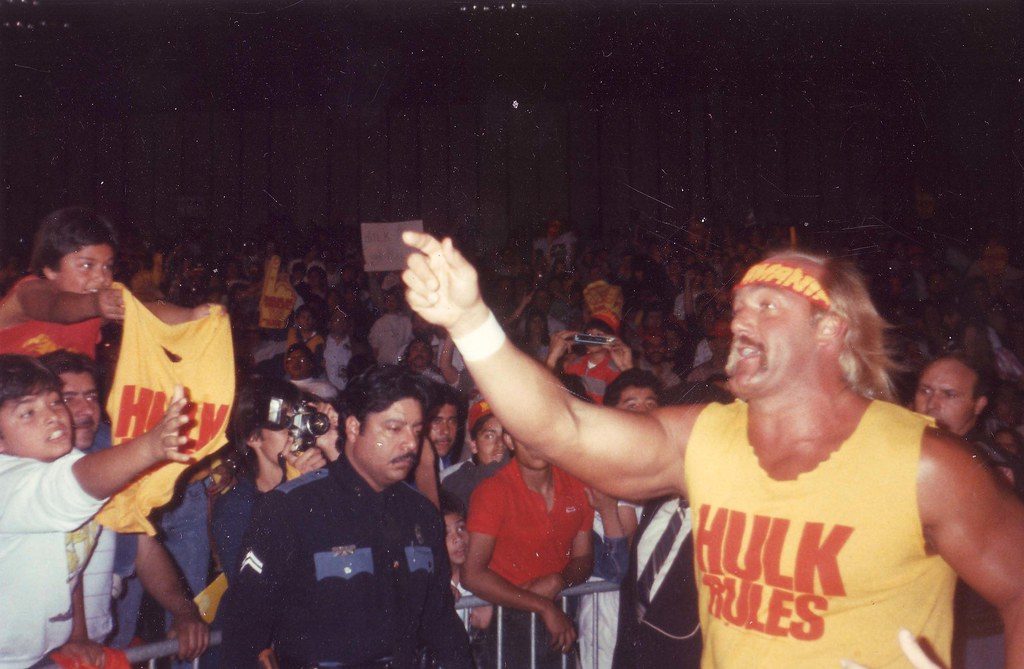
Hulk Hogan, 1953–2025
He sold America a simple bargain: believe hard enough, flex long enough, and the world will move for you.
Hulk Hogan didn’t just wrestle in the 1980s and 1990s. He towered over them, a bleach-blond, bandana-wearing billboard for a kind of loud, uncomplicated optimism that professional wrestling turned into mass entertainment. Born Terry Gene Bollea on August 11, 1953, in Augusta, Georgia, Hogan became the face people picture when they picture “wrestling” at all: the mustache, the ripped shirt, the pose that asked the crowd to get louder and then rewarded them for it.
Ring Names: Terry Boulder, Sterling Golden, Super Destroyer, Hulk Hogan, Hollywood Hogan, Mr. America
His origin story in the ring began in the late 1970s, but the moment the machine truly locked into place came after he joined the World Wrestling Federation in 1983. A year later, in 1984, Hogan beat the Iron Sheik at Madison Square Garden to win his first WWF Championship. That victory didn’t land like a routine title change. It felt like a coronation, the start of a four-year reign that became a reference point for what a “top guy” looked like in that era.
It wasn’t the longest reign in company history, not compared to Bob Backlund or Bruno Sammartino, but it became the last long WWF championship run until Roman Reigns captured the title in 2020.
Hogan’s résumé reads like a list of wrestling’s biggest stages because, for a long stretch, wrestling’s biggest stages were built around him. WrestleMania I in 1985 paired him with Mr. T against Roddy Piper and Paul Orndorff, a celebrity-fueled gamble that helped cement WrestleMania as the company’s flagship event. WrestleMania III in 1987 delivered the image that still gets replayed like a national myth: Hogan body-slamming the 520-pound Andre the Giant in front of a record-setting crowd, a moment that welded spectacle to legend and made “Hulkamania” feel less like a gimmick than a shared memory.
The championships followed in bulk. Hogan became a six-time WWF/WWE Champion and a six-time WCW World Heavyweight Champion, a rare dual-era dominance that tracked wrestling’s shifting power centers while keeping him near the top of the poster.
Outside the ring, he chased the same kind of broad, family-facing fame that his character promised. He starred in films including Suburban Commando and Mr. Nanny, and led the television series Thunder in Paradise. He appeared on TV shows and in commercials, crossing over into the kind of household-name status that wrestling has always wanted for its stars and rarely achieves at that scale.
But the Hogan story never stayed purely heroic for long. His career carried scandals, including a high-profile racial slur incident that led to a temporary severance from WWE. The company later brought him back, and he was reinstated into the WWE Hall of Fame in 2018, a return that underscored how wrestling, as an industry, often struggles to separate its icons from their damage.
Hogan died on July 24, 2025, after complications from a surgery. He was 71.
What remains is the contradiction at the center of his fame: a performer who helped push wrestling into the mainstream, who made millions feel like they were part of something bigger, and whose legacy also includes the moments that forced fans and companies to decide what they were willing to forgive in exchange for the memories.
Leave a Comment