
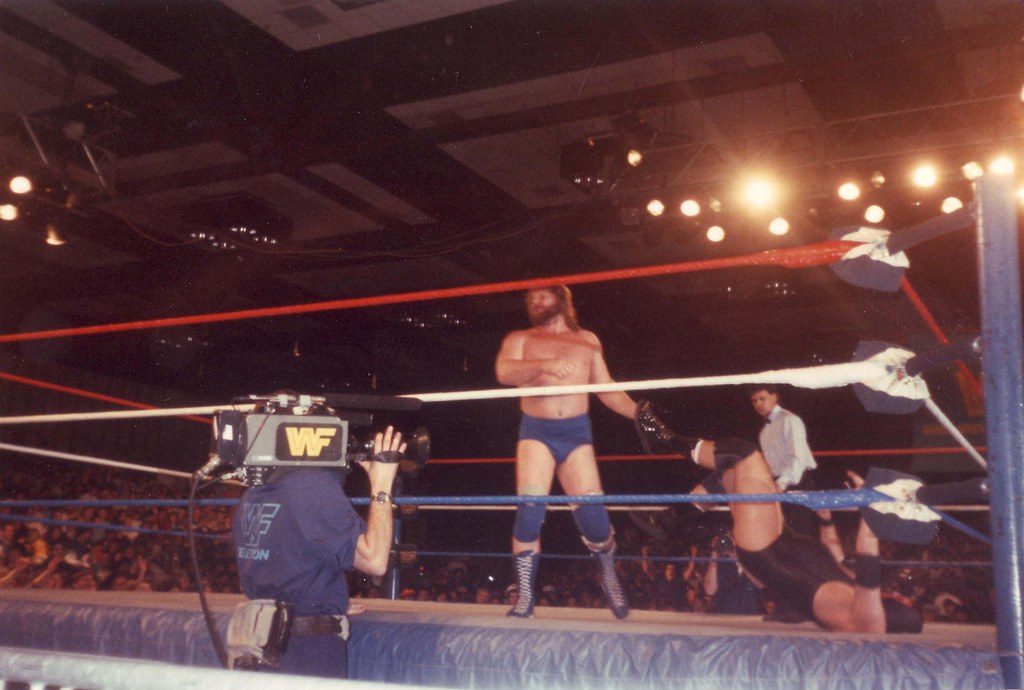
The first Royal Rumble was framed like a novelty, but it was handled like a prototype. That’s the part people forget. WWF didn’t stumble into a classic on January 24, 1988. They stress-tested a format on cable, in a building that wasn’t a stadium, with a field that wasn’t 30, and with stakes that weren’t yet welded to WrestleMania. Behind the curtain, the whole thing had the unmistakable feel of a company trying to see if a new machine would actually run.
The first Royal Rumble: a “test run” that didn’t feel like one
It’s strange to call the first Royal Rumble a “beginning” when it already arrived with the confidence of something that felt inevitable. Thirty men hadn’t become the standard yet. The match wasn’t the main event yet. And the idea of a timed-entry battle royal as a yearly compass for WrestleMania direction wasn’t yet the industry’s most reliable machine.
But on January 24, 1988, the WWF put the concept on the board anyway. Not as a grand stadium spectacle, but as a cable special on the USA Network. In hindsight, that choice reads like caution with a plan. If the idea flopped, it flopped on cable. If it worked, WWF had something it could scale.
This show was a proof of concept: a new match type built to create constant motion, constant entrances, constant reasons to keep watching. The Rumble wasn’t built to be “the best match.” It was built to be the most dependable format.
Before the Rumble: the card and the roads that led there
Ricky “The Dragon” Steamboat vs. “Ravishing” Rick Rude (with Bobby “The Brain” Heenan)
This was the kind of pairing the late-’80s WWF loved: a clean-cut technician against a man who treated arrogance like a finishing hold. Rude, flanked by Heenan, was positioned as a heat magnet, someone who didn’t need a title to feel like a problem. Steamboat was the antidote: steady, credible, hard to rattle.
Heenan’s presence also tells you how WWF liked to do business in that era. Attach Heenan, and the audience is trained to assume the guy matters. It’s character work, but it’s also a shortcut to importance.
The match worked because the roles were clean. Rude didn’t need to outwrestle Steamboat to control the room; he just had to make people want to see him get caught. Steamboat didn’t need to “prove” anything; he just had to keep the pace honest and survive the traps.
Result: Rick Rude defeated Ricky Steamboat.
Why it mattered: Rude winning here wasn’t subtle. It was WWF telling you he belonged higher up the card, and that Heenan’s orbit could tilt outcomes even when championships weren’t involved.
The Jumping Bomb Angels (Noriyo Tateno & Itsuki Yamazaki) vs. The Glamour Girls (Judy Martin & Leilani Kai) — 2-out-of-3 Falls, WWF Women’s Tag Team Championship
If the men’s side of the show leaned on personality and momentum, this match leaned on structure. Two-out-of-three falls forces a story: adjustments, endurance, and the pressure of knowing you can’t steal one fall and coast.
It also served as a snapshot of the late-’80s women’s tag scene at its strongest. The Jumping Bomb Angels were widely regarded as an elite in-ring team, and the stipulation functioned like a stamp that said: take this seriously. WWF didn’t always frame women’s wrestling with “big match” architecture. Here, it did.
Result: The Jumping Bomb Angels defeated The Glamour Girls, 2 falls to 1, to win the WWF Women’s Tag Team Championship.
Why it mattered: Title changes in a two-out-of-three falls match land with extra weight. It signals legitimacy. It also gave the special something it needed: a major championship swing on a night where the new concept still had to earn trust.
The Royal Rumble match: the experiment that stuck
Royal Rumble Match (20-man)
The first Royal Rumble is easy to misread if you only know what the match became. This wasn’t yet the WrestleMania golden ticket. It was a concept being tested in public: timed entrances, shifting alliances, sudden reversals, and the simple truth that endurance and timing can matter as much as star power.
The timed-entry hook was the whole wager. WWF was building a format that could manufacture momentum even when the match itself wasn’t a technical showcase. Every entrance is a reset. Every entrance is a pop opportunity. Every entrance is a new story beat.
Winner: Jim Duggan.
Duggan outlasting the field, gave the night a through-line. It also told you how WWF saw him in that moment: not necessarily as “the guy,” but as a crowd-approved winner who could make a brand-new match concept feel satisfying on its first night out.
What it set the stage for
The 1988 Royal Rumble didn’t yet function as a formal WrestleMania matchmaker the way later editions would. There was no guaranteed title shot attached to the win, no explicit road paved in the ring.
And maybe the most important truth here is the simplest one: WWF learned the format could carry itself. Once you have a match where something new happens every two minutes, you’ve built a structure that can survive almost any roster era. That’s why the Rumble became tradition. It wasn’t magic. It was repeatable.
But, we said at this point in its history, the rumble match itself wasn’t the main event. The honor of the main event on this match may surprise you.
Islanders vs. Young Stallions (2 out of 3 falls)
A 2-out-of-3 falls format forces clarity. You can’t live off one hot stretch or one cheap break. You have to win, adjust, and then win again. That structure mattered on this particular night because the whole show was, in its own way, an audition for repeatability. The Rumble was the new machine. This was the control test: a traditional tag stipulation that demanded pacing, teamwork, and momentum management.
The Islanders and The Young Stallions worked under that pressure, with the match’s identity coming from the format itself: falls as chapters, each one resetting the stakes and forcing the teams to answer what just happened. That’s the quiet appeal of 2-out-of-3 falls. It turns tag wrestling into a series of problems that have to be solved in real time.
Watching this match now, two things become clear. The audience was already exhausted from the Royal Rumble, and the match was slow moving and a slog to end the night with.
The Result: The Islanders won the match, making it the second match of the night where members of The Heenan family won the match.
Leave a Comment